Changsha, China – October 2026 – A research team led by Prof. Wu at the College of Mechanical and Electrical Engineering (CMEE) has made new progress in the precision molding and scalable manufacturing of hollow microneedles. In collaboration with the Institute of Medical and Biological Engineering at the University of Leeds in the UK, Zhuhai Jingmo Co., Ltd., and the State Key Laboratory of Powder Metallurgy at Central South University, the team has published a research paper in Small (IF: 12.1). The paper, titled “Precision Injection‐Compression Molding and Functional Integration of Hollow Microneedle Microfluidic Chips for Minimally Invasive Continuous Health Monitoring,” examines manufacturing solutions for hollow microneedle devices intended for wearable health monitoring. Dr. Baishun Zhao, a postdoctoral fellow at Central South University, is the first author. Prof. Wangqing Wu and Prof. Dou Zhang of the Powder Metallurgy Research Institute are co-corresponding authors.
At a recent meeting on interdisciplinary collaboration between engineering and medicine, jointly organized by the CMEE and Xiangya Hospital, Prof. Wu highlighted precision, high-volume manufacturing technologies for BioMEMS-based diagnostic and therapeutic devices, including hollow microneedles and microfluidic chips. Addressing practical clinical needs in minimally invasive, wearable health monitoring, the work reflects the college's ongoing efforts to advance engineering–medicine integration and apply advanced manufacturing technologies to healthcare.
Hollow microneedles can collect interstitial fluid through tiny channels within the needle body, providing a technological foundation for minimally invasive, wearable health monitoring. However, their small dimensions and intricate structures pose significant manufacturing challenges. The molding process must preserve the integrity of both the needle tips and the internal channels while preventing damage to the delicate core pins used to form the hollow structures. Achieving high-precision, consistent and repeatable molding at scale is therefore a key step toward practical application.
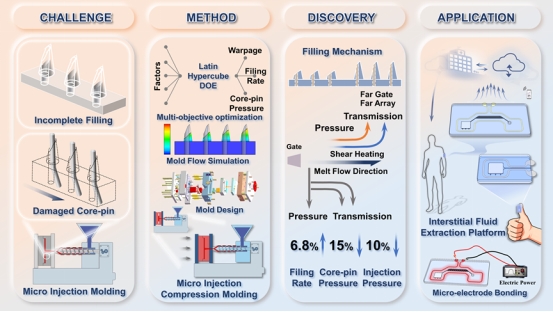
To address these challenges, the team combined molding simulations, process experiments and multi-objective optimization to investigate how mold layout and processing parameters affect hollow microneedle quality. The results showed that positioning the microneedle array farther from the injection gate improved microstructure filling and reduced the impact force on the needle cores by approximately 15%. With the optimized injection-compression molding process, the filling rate increased by approximately 6.8%, with an average needle height of 740 μm, while injection pressure decreased by approximately 10%. During continuous molding tests, the cycle time was approximately 35 s. Across more than 50 consecutive cycles, the proportion of microneedles meeting the filling-quality requirements remained above 94%, demonstrating the process’s potential for consistent replication and high-volume manufacturing. The team also integrated the molded hollow microneedle arrays with microchannels and chip-packaging structures to create an interstitial fluid collection device. Tests using ex vivo porcine skin achieved a microneedle penetration success rate of approximately 95%. Preliminary animal experiments also demonstrated interstitial fluid extraction, providing an initial basis for further evaluation of device performance and long-term use.
In recent years, the team has focused on efficient, precision molding of hollow microneedles and the integrated manufacturing of microfluidic chips. Its work has resulted in a series of original research publications in leading international journals, including Chemical Engineering Journal (CEJ; IF: 13.2), Materials & Design (M&D; IF: 9.1) and Journal of Materials Research and Technology (JMR&T; IF: 7.2). Building on the team’s earlier work on the integrated bonding of microfluidic chips to achieve coordinated control of structural integrity and functional performance, the present study establishes a continuous technical pathway from microstructure fabrication to functional device integration. The team has fabricated chips with burst strengths ranging from 0.5 to 2.9 MPa, while keeping microchannel deformation below 10%, supporting their adaptability to a range of application scenarios. Its manufacturing process can also consistently produce hollow microneedles with minimum feature sizes of 30 μm, aspect ratios of up to 4:1, wall thicknesses as low as 30 μm and heights exceeding 650 μm. The coefficient of variation between batches is below 1%. The microneedles have a maximum load-bearing capacity of approximately 0.26 N (compared to the ~0.2 N required for skin penetration).
These results provide manufacturing-process support for the cost-effective, high-volume production of hollow microneedle microfluidic devices, bringing continuous health-monitoring systems closer to industrial application. Moving forward, the team plans to leverage the college’s medical-engineering collaboration platform to further align with clinical needs, refine device validation, and facilitate the translation of engineering innovations into bedside solutions.
First Review | Peng Xinmei
Second Review | Wu Wangqing
Third Review | LI Lingzhi